
Quick answer:
Businesses increase efficiency with CNC mandrel benders by replacing manual setup, trial bends and welded joints with programmed, repeatable bending. A CNC mandrel bender stores each part as a program, supports the tube internally so it doesn’t wrinkle or collapse, and completes several bends in one cycle. The result is faster changeovers, far less scrap, fewer welds, consistent quality across shifts and less reliance on a single skilled operator. Manufacturers in automotive, aerospace, maritime, furniture and architecture use them to produce more parts, to tighter tolerances, with the same team.
At a glance, the main efficiency gains are:
- Faster setup and changeover through stored programs and CAD import
- Less scrap, because the first bend is right far more often
- Fewer welded joints, since one bent tube replaces several cut and welded pieces
- Multiple bends per cycle, cutting handling time
- Consistent output, whoever is running the machine
- Safer, less physically demanding work for operators
Why efficiency is the real reason businesses switch
Ask most production managers why they bought a CNC mandrel bender and they won’t start with “precision”. They’ll talk about time.
Time lost setting up. Time lost on test bends that end up in the scrap bin. Time lost waiting for the one operator who knows how to get that awkward exhaust part right.
Precision matters, of course. But for most businesses, the real win is getting good parts out of the door faster, with fewer people standing around waiting.
In this guide, we’ll look at exactly where those gains come from, what they look like on a real shop floor, and how to make sure you get them too.
What is a CNC mandrel bender?
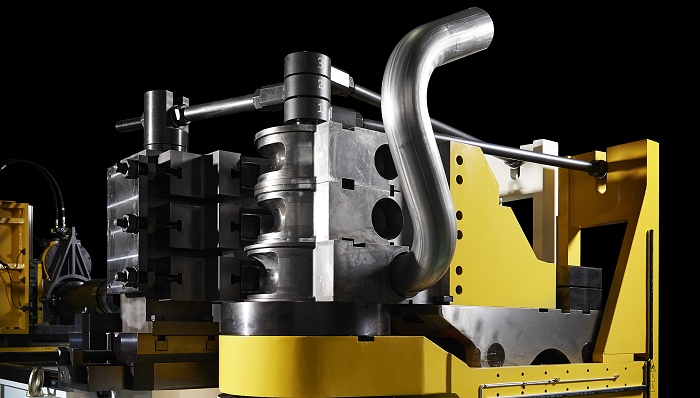
A CNC mandrel bender is a rotary draw tube bending machine controlled by a computer. It uses a mandrel, a rod with a flexible ball-shaped tip, inserted inside the tube to support it while it bends.
The CNC side handles the movement. It controls the feed length, the rotation of the tube between bends, and the bend angle itself. Each part becomes a saved program you can recall in seconds.
A simple way to picture it
Try bending a drinking straw sharply. It kinks and flattens, right? Now slide a thin pipe cleaner inside and bend it again. It holds its round shape.
That’s the mandrel. It stops the inside of the bend from wrinkling and the outside collapsing, which is what lets you bend thin-walled or tight-radius tube without ruining it.
Now imagine the straw-bending is done by a machine that remembers every angle, every length and every twist, perfectly, every time. That’s the CNC part.
How it differs from manual and NC bending
| Machine type | How it’s controlled | Best suited to |
| Manual bender | Operator positions and bends by hand | Low volume, simple bends |
| NC bender | Bend angle controlled, feed and rotation set manually | Medium volume, simpler parts |
| CNC mandrel bender | Feed, rotation and bend all programmed | High volume, complex multi-bend parts, tight radii |
If you’re weighing up the options, our guide to CNC tube bending machines explains the different configurations in more detail.
Where the efficiency gains actually come from
Most articles stop at “CNC is faster”. That’s true, but it doesn’t help you build a business case. Here’s what is really happening behind the numbers.
1. Setup goes from hours to minutes
On a manual or semi-automatic machine, every new job means measuring, marking, test bending and adjusting. A complex part can eat half a shift before a single good piece is made.
With CNC, the part lives as a program. Call it up, fit the right tooling and go. Many modern machines also import CAD or XYZ data directly, so engineering can send a drawing straight to the shop floor.
That matters most for businesses making lots of different parts in small or medium batches. The more changeovers you do, the more time you get back.
2. Scrap rates drop sharply
Tube isn’t cheap, especially stainless, titanium or aerospace-grade aluminium. Every test bend that misses the mark is money in the bin.
CNC mandrel benders compensate for springback automatically once the material is set up. The mandrel and wiper die prevent wrinkling and ovality. So the first good part arrives sooner, and the hundredth looks exactly like the first.
Want to know where scrap usually creeps in? Our post on common tube bending mistakes and how to avoid them covers the usual culprits.
3. Fewer welds, fewer joints, less finishing
This is the gain people underestimate. Without a mandrel, tight bends in thin-wall tube often aren’t possible. So fabricators cut straight lengths, mitre them and weld them together.
Each weld means cutting, prepping, welding, grinding, polishing and often inspection. One US machinery supplier described visiting a customer doing hundreds of hours of exactly that work, when a mandrel bender could have produced the same pipework with a two-person team in a fraction of the time.
A single bent tube is also stronger and cleaner looking than a welded assembly, with no joint to leak or corrode.
4. More bends per cycle, less handling
A CNC mandrel bender can complete a full multi-bend part in one cycle. It feeds, rotates and bends, then repeats, without anyone repositioning the tube.
Multi-stack machines take this further. They hold several sets of tooling at once, so a part needing two different bend radii can still be made in one go. Left and right bending machines can bend in both directions, which helps with complex 3D shapes that would otherwise clash with the machine.
5. Consistency that doesn’t depend on one person
Every shop has that one operator who “just knows” how to get a tricky part right. When they’re off sick or on holiday, output drops.
CNC takes that knowledge and stores it in the program. A newer operator can load the same job and produce the same result. It’s a bit like the difference between a family recipe in someone’s head and one written down step by step; anyone can follow the written one.
6. Safer, less tiring work
CNC benders take the physical strain out of bending. Operators load and unload rather than wrestling tube by hand. Modern guarding and light curtains keep hands clear of moving tooling.
Less fatigue means fewer mistakes late in a shift, and that feeds straight back into efficiency.
What it looks like in the real world
Theory is useful. Seeing it on a shop floor is better.
A heavy-industry example: hydraulic press pipework
A large hydraulic press manufacturer in Spain brought in a fully CNC mandrel bender to speed up production of the complex pipework inside its presses. The tubes connect to fixed inlets and outlets, so even half a degree out causes fitting problems.
The brief was clear. They needed direct CAD import without data loss, storage for a huge library of different parts, and repeatable accuracy. The supplier reported faster cycle times, less waste and quicker tooling setup, giving a much leaner process overall.
The lesson? When parts must fit first time, CNC repeatability isn’t a nice extra. It is the efficiency gain.
Typical scenarios across UK industries
The examples below are typical of what we see when manufacturers move from manual or NC bending to CNC mandrel bending.
- Automotive. A supplier making exhaust and brake line components runs dozens of part numbers a week. Stored programs mean changeovers take minutes, not hours, and mandrel support keeps thin-wall exhaust tube round through tight bends. See how this works for automotive tube bending.
- Aerospace. Hydraulic and fuel lines need tight tolerances and full traceability. A CNC machine repeats the same bend data on every part, which cuts rework and makes inspection simpler. More on aerospace tube bending.
- Maritime. Boatbuilders producing stainless handrails and balustrades swap multiple welded joints for single bent sections. That means less polishing, a cleaner finish and fewer weak points for salt water to attack. Read about maritime tube bending.
- Furniture. Office and educational seating frames are built in high volumes from thin-wall tube. Multi-bend cycles and consistent quality keep pace with large orders without adding shifts. Learn more about furniture tube bending.
- Home and garden. Garden furniture, tool handles and refrigeration pipework all benefit from fast, repeatable bends on lighter tube sizes.
- Architecture. Handrails and feature pieces often need long, flowing bends that look seamless. CNC mandrel bending delivers clean curves without kinks, so less finishing is needed on site.
Quick comparison: before and after CNC mandrel bending
| Area | Manual or NC bending | CNC mandrel bending |
| Changeover | Measure, mark, test bend, adjust | Recall program, fit tooling |
| Complex parts | Often cut and welded | Bent in one piece |
| Thin-wall or tight radius | Risk of wrinkling or collapse | Supported by mandrel and wiper die |
| Consistency | Depends on the operator | Depends on the program |
| Scrap | Higher, especially on new jobs | Lower, right sooner |
| Operator effort | High | Load, unload, monitor |
How to get the same results in your business
Buying a CNC mandrel bender doesn’t guarantee efficiency on its own. The businesses that see the biggest gains get a few things right from the start.
Match the machine to your parts
Start with your parts, not the brochure. Look at tube diameter, wall thickness, material, bend radius and how many bends each part needs.
For example, the SOCO SB Auto Series covers capacities such as 39mm and 63mm, while the SOCO All Electric Left & Right Series suits complex 3D parts that need bending in both directions.
Don’t skimp on tooling
Tooling is where a lot of efficiency is won or lost. The wrong mandrel, wiper die or clamp die leads to wrinkles, marks and scrap, however good the machine.
Purpose-made bespoke tooling designed around your parts pays for itself quickly in fewer rejects and faster setups.
Build a program library
The real power of CNC grows over time. Every part you program is one you never have to set up from scratch again.
Our guide to optimising production with CNC tube bending programs shows how to get more from your stored programs.
Think about the whole cell
Bending is only one step. If your saw or end finishing can’t keep up, the bender sits idle.
Pairing it with accurate tube saws and tube finishers keeps parts flowing through the cell without bottlenecks.
Plan for materials
Stainless, aluminium and newer lightweight alloys each behave differently. Springback, wall thinning and surface finish all change. Our post on innovative materials in tube bending explains what to watch for.
Keep it running
Downtime wipes out efficiency gains fast. Regular servicing and quick access to spare parts keep the machine earning. Every new machine from Langbow comes with a 5-year warranty and annual servicing as standard.
Consider a used CNC bender
Not every business needs a brand-new machine to see the benefits. A refurbished, tested machine can be a smart way to add CNC capacity on a tighter budget. Browse our current used tube machinery stock to see what’s available.
Summary
CNC mandrel benders make businesses more efficient in ways that go well beyond speed. They cut setup time with stored programs. They reduce scrap by getting parts right sooner. They replace welded assemblies with single bent tubes, and they keep quality consistent no matter who is on shift.
The businesses that gain the most pair the right machine with the right tooling, build up a program library and keep the machine well maintained.
With more than 50 years in tube machinery, over 600 machines installed across the UK, and sole distribution of SOCO in the UK and Ireland, Langbow can help you find the right fit. Request a quote or call 01889 575 380 to talk through your parts with our team.
Frequently asked questions
How much faster is a CNC mandrel bender than a manual bender?
It depends on the part, but the biggest saving is usually in setup rather than bending speed. Once a part is programmed, changeover can drop from hours to minutes, and complex multi-bend parts are completed in a single cycle without repositioning by hand.
Is a CNC mandrel bender worth it for small batch production?
Often, yes. Small batches mean frequent changeovers, which is exactly where stored programs save the most time. If you make many different parts in low or medium volumes, CNC can deliver a faster return than you might expect.
What materials can a CNC mandrel bender handle?
Most machines bend mild steel, stainless steel, aluminium, copper and titanium tube. Each material behaves differently, so the right tooling and program settings for springback and wall thinning are key to good results.
Do I need a specialist operator to run a CNC mandrel bender?
You need someone trained to program and set up the machine, but day-to-day running is far less skill-dependent than manual bending. Once programs are saved, a less experienced operator can produce the same quality parts as a senior one.
Should I buy a new or used CNC mandrel bender?
A new machine gives you the latest controls and a full warranty, such as Langbow’s 5-year warranty on new machines. A refurbished, tested used machine is a cost-effective way to add CNC capacity quickly. The right choice depends on your budget, volumes and the complexity of your parts.