
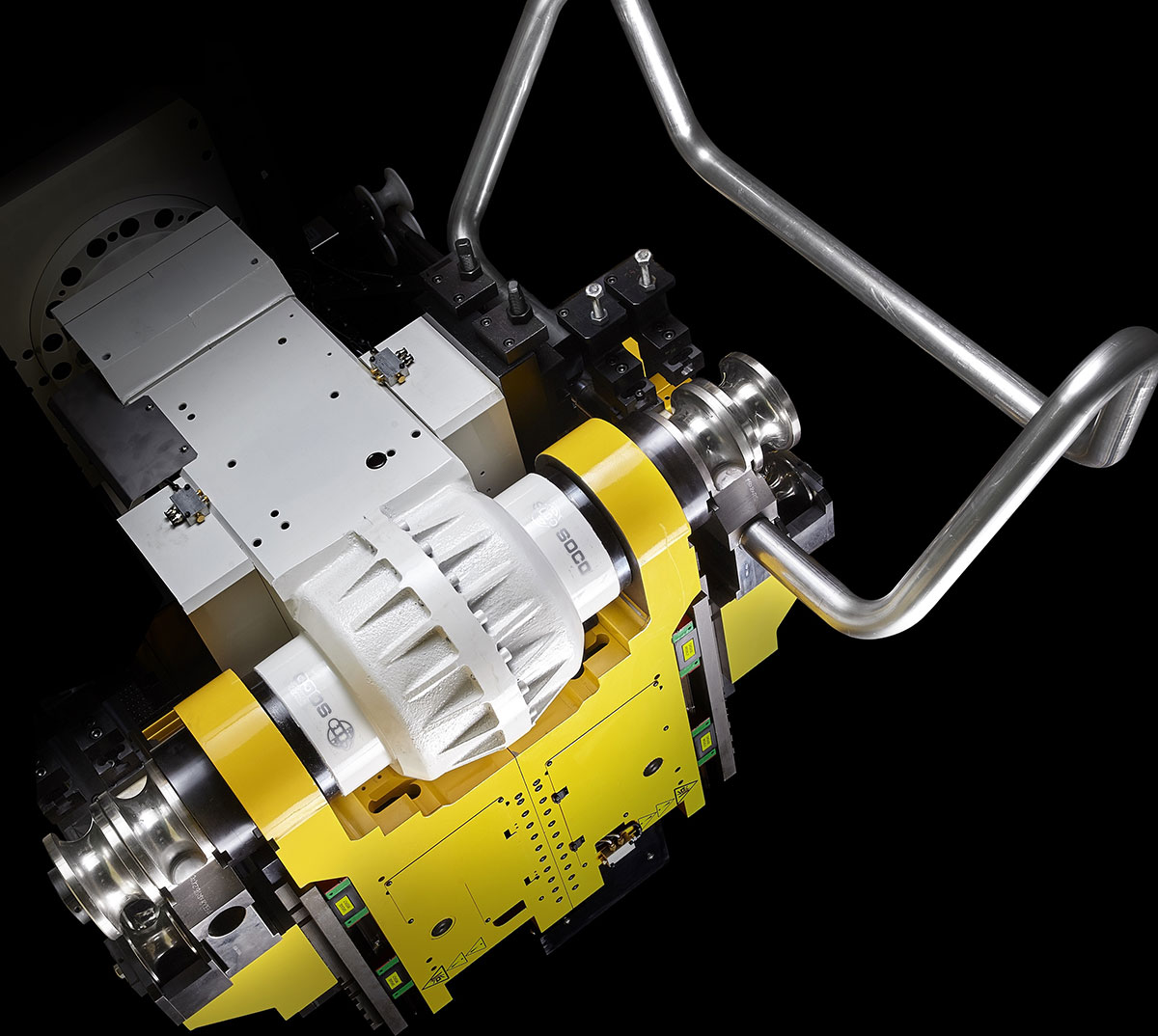
Software is no longer a bolt-on feature of a CNC tube bending machine. On modern machines, it is the system that connects design intent to physical output, managing everything from how a part is programmed to how the machine compensates for material behaviour in real time.
Quick answer: In modern tube bending, software handles CAD import and geometry conversion, bend sequence simulation, springback and elongation compensation, tooling management, offline programming, and production traceability. Together, these functions eliminate the trial-and-error that defined manual and early NC bending, replacing it with repeatable, data-driven precision from the first part.
This article covers each of those roles in plain terms, and explains why the software capability of a machine matters just as much as its mechanical specification.
From drawing to bend data: design and geometry conversion
The first job software does is translate a design into something a machine can act on. When a part is designed in CAD, the geometry exists as a 3D model, a visual representation of what the finished tube should look like. That model needs to be converted into machine-readable bend data before any physical work can begin.
Modern tube bending software imports standard CAD formats such as STEP and IGES and automatically extracts the bend sequence from the geometry. It outputs this as coordinate data, typically expressed as bend angle, rotation angle, and distance between bends (commonly referred to as YBC format). What previously required a programmer to manually calculate and enter each parameter is now done automatically, in seconds, with significantly less room for transcription error.
This matters practically because it shortens the time between receiving a new part drawing and running the first bend. For manufacturers handling frequent changeovers or complex part families, that compression of setup time directly improves capacity.
Related: Optimising Production with CNC Tube Bending Programs
Virtual simulation before the first piece of material is touched
Once a bend programme exists, modern software simulates the entire bending sequence before any tube is loaded into the machine. The simulation models the tube moving through each bend in sequence, checking for collisions between the tube, the machine frame, the mandrel, the dies, and any tooling components in the working envelope.
This step is more valuable than it might initially appear. Collision detection in simulation costs nothing. A collision on the machine costs time, material, and potentially tooling or machine damage. For complex multi-bend parts with tight inter-bend distances, the simulation step is not optional; it is the only practical way to validate a programme before committing material.
Simulation also allows engineers to explore alternative bend sequences. Sometimes reordering the bends eliminates a collision that would otherwise require a physical workaround. Software can identify those options automatically.
Related: Common Tube Bending Mistakes and How to Avoid Them
Springback and elongation compensation
This is where tube bending software earns its keep most visibly. When a tube is bent and the tooling releases, the material springs back partially toward its original shape. The degree of springback depends on the material, its wall thickness, the bend radius, and whether the tube was bent with or without a mandrel. Without compensation, every bend would be slightly under-angle, and achieving the correct final geometry would require iterative trial bending.
Modern bending software applies springback compensation automatically. It calculates the expected springback for the specific material and geometry based on programmed material properties, then overbends by the calculated correction so the part lands at the correct angle after release. Similarly, elongation compensation adjusts for the fact that bending stretches the material on the outside of the bend, which slightly affects the distances between bends in a multi-bend part.
The practical result is that the first physical bend is far closer to specification than it would be without compensation, reducing scrap and first-article setup time significantly.
Related: How Tube Material Affects Bending Performance
Tooling management
A busy tube bending operation carries a significant inventory of dies, mandrels, wiper dies, and clamp blocks across multiple machine sizes and bend radii. Keeping track of what is available, what is compatible with an incoming job, and what condition it is in is a non-trivial task that becomes a production bottleneck if handled informally.
Tooling management software addresses this directly. Programmes are linked to specific tooling sets, so when a job is scheduled, the system can confirm whether the required tooling is available and in acceptable condition. It can suggest compatible alternative die combinations if the preferred set is in use on another machine. It also tracks die wear over production cycles, giving maintenance teams advance warning before tooling degradation starts affecting part quality.
For operations running multiple machines simultaneously or managing tooling across sites, this capability is the difference between a structured approach to tooling and constant reactive problem-solving.
Langbow supplies SOCO CNC tube bending machines with integrated software as standard. Talk to our team about what the right machine can do for your production. Get a free quote.
Offline programming: building programmes without stopping production
On older machines, programming a new part meant occupying the machine while a programmer worked at the control panel. Every minute spent programming was a minute of lost production. Offline programming removes that constraint entirely.
Office-based software lets programmers build, simulate, and validate bend programmes at a desktop workstation, completely independently of the machine. Once the programme is ready and collision-checked, it is transferred to the machine and the operator loads it directly. The machine moves from one job to the next with minimal interruption.
For operations with a high mix of part numbers or frequent new part introductions, offline programming is one of the most significant productivity tools available. It also means programming can happen in parallel with production rather than sequentially, which effectively adds capacity without adding machines.
Real-time machine control and closed-loop correction
During the bend itself, the software is actively managing the machine rather than simply executing a static programme. Servo axes are monitored and corrected in real time to maintain positional accuracy across the bending cycle. Force feedback from the bending head can be used to detect anomalies, such as a tube that has slipped in the clamp or a mandrel position that is outside tolerance, and alert the operator before a defective part is completed.
On more advanced machines, closed-loop systems measure the actual bend angle during or immediately after the bend and compare it against the target. If the measured angle falls outside the tolerance band, the system can apply a correction to the next bend automatically, without operator intervention. This capability is particularly valuable in high-volume production where stopping to measure and correct manually would create significant throughput loss.
Production traceability and data output
Increasingly, manufacturers supplying into aerospace, automotive, and other regulated sectors are required to demonstrate process traceability. Software on modern CNC benders logs production data for each part: the programme used, the machine settings, the time and date of production, and any corrections applied. This creates a production record that can be retrieved for quality audits or customer inspection requirements.
Beyond compliance, that data is genuinely useful for process improvement. Patterns in correction data can reveal that a particular material batch has different springback characteristics from specification, or that a die is wearing faster than expected on a specific part geometry. Software turns those signals into actionable information rather than leaving them buried in production noise.
Related: What Maintenance Tips Are Important for Tube Bending Equipment?
Why software capability should be part of your machine specification
When evaluating CNC tube bending machines, it is natural to focus on mechanical specifications: capacity, bend radius range, axis count, and cycle speed. But the software running the machine determines how much of that mechanical capability you can actually access and how efficiently you can use it.
A machine with excellent mechanics but limited software will require more manual intervention, more trial bending, and more operator skill to achieve consistent results. A machine with strong software integration reduces the dependence on individual operator knowledge, shortens setup times, and produces more consistent output across shifts and operators.
If you are specifying a new CNC tube bending machine, the questions worth asking about software include: does it support offline programming; what CAD formats does it import natively; how does it handle springback compensation; and what data does it log and export?
View Langbow’s CNC tube bending machines
Talk to Langbow about CNC capability for your operation
Langbow has been supplying tube bending machinery across the UK and Ireland for over 50 years. We supply SOCO CNC tube bending machines, which come with integrated control software as standard, and we support customers through installation, commissioning, and operator training so the software capability is actually used from day one.
If you want to understand how a modern CNC machine and its software would fit your specific production requirements, talk to our team. We will give you a straight answer.